What If the Next Level Isn’t Higher??
Why reaching a plateau may mean you have outgrown the way you used to grow.
Reading time: 3 minutes
Summary
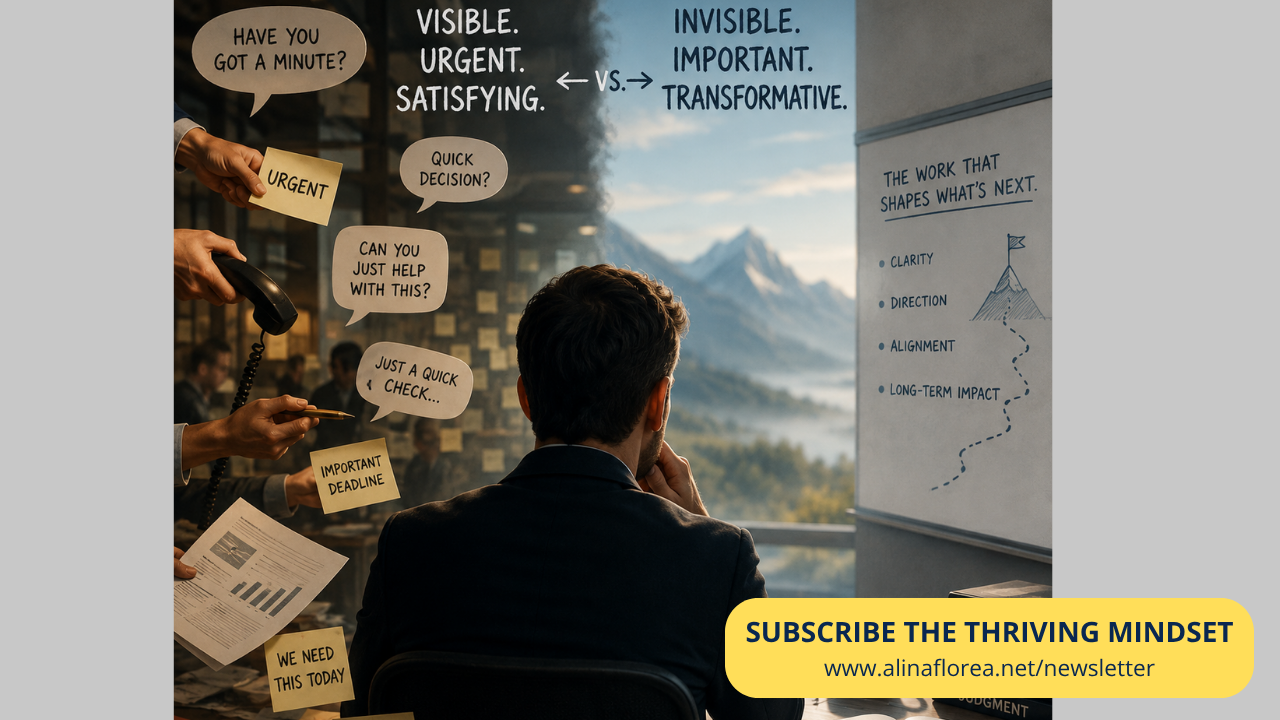
For accomplished leaders, reaching a plateau can feel like a signal that it is time to find the next challenge, acquire another capability or move towards a bigger arena — yet sometimes the familiar architecture of growth is precisely what makes the next level difficult to see.
This article explores what happens when the ways of growing that have served us exceptionally well — learning, achieving, solving, expanding our influence — continue to produce progress without necessarily producing something genuinely new. At a certain point in a mature career, the question may no longer be how much further we can go, but whether we can recognise a form of growth that does not resemble the growth we already know.
Before deciding if this article is for you, consider:
- When you reach a plateau, is your instinct immediately to look for the next challenge?
- Does growth still mean more knowledge, responsibility, influence or complexity?
- How often does reaching something important quickly turn into "What is next"?
- Could you be looking for a new level through an old definition of progress?
- If your next level did not look like an achievement, would you recognise it?
A few days ago, I spoke with someone whose career had already taken her through an extraordinary range of roles, responsibilities, and professional contexts. The more I listened, the more my admiration grew for the deliberate way she shaped her development: stepping into unfamiliar territory, learning whenever she felt there was something she did not yet understand, taking on increasingly complex responsibilities, and continuously expanding the contexts in which she could contribute.
What struck me just as much was the confidence with which she spoke about her path. She wasn't searching for it. She knew she was on the right one, a path in which she had invested enormous energy, vision and trust in her own capacity to keep moving forward.
And then she told me that at times she feels like having reached a plateau. And that is her signal that she needs to find something else, a new challenge that would make her feel intellectually challenged. And every time she reaches a new plateau, she could feel there is another level for her. What she could not yet see was what that level looked like.
What stayed with me after our conversation was not whether there was another level. I had little doubt there was. It was something else:
When we have spent decades becoming exceptionally good at moving forward, how do we know that the next level will still look like forward?
I recognised that question because, for a long time, I knew exactly what to do with a plateau. Until one day when I could not find the right door to access the next level, despite the larger projects and responsibility I used to take on.
For people who have spent much of their adult lives growing, a plateau is rarely experienced as an achievement. We may acknowledge what has been accomplished, perhaps even enjoy it for a while, but fairly soon another question appears: What is next?
There is nothing inherently problematic about that question. I have lived a good part of my professional life through it. What interests me now is how easily we assume that the answer must have the same architecture as everything that came before it.
I knew what to do with a plateau
During my years as Managing Director, I went through five significant stages of organisational capability growth. Each brought the company to a level that, some years earlier, would have looked very ambitious.
And each eventually became normal.
I remember being almost grateful for the “bad luck” of having something else that needed attention. A market change, a structural limitation, a new business requirement or an ambition from the shareholders would give me another organisational lever to work on. I could start engineering the organisation again.
I use the word deliberately. My engineering background probably had a lot to do with the pleasure I took in it. I could look at the organisation as it was, look at what the shareholders and clients wanted it to become, understand what the context would allow and start working on the distance between the two.
Sometimes that meant structure. Sometimes processes, capabilities, roles, management practices or a different distribution of responsibility. Usually several of them had to move together.
And all these transformations I helped create worked remarkably well.
The organisation became capable of something it had previously been unable to do. Performance improved significantly. The new way of operating settled in. What had initially required enormous attention became simply the way things were done.
I would look at it and think: Cool!
And then, fairly quickly: What is next?
I didn't see anything unusual in that. This was growth. You reached one level, consolidated it and started looking for the next one.
The staircase can become very sophisticated
Many high achievers become exceptionally good at this.
With experience, the staircase stops being a crude collection of promotions, titles or money. They manage fairly quickly to move beyond the imposter, and demonstrating is no longer just a way to exorcise that imposter. The achievements become more sophisticated. We want broader responsibility, greater influence, more complex problems, deeper knowledge, a broader or even a board role, an international assignment, another field to understand.
Learning itself continues to be part of the achievement architecture. You identify an area where your understanding is incomplete and study it. You discover another perspective from various stakeholders and integrate it. You deliberately enter situations that stretch you because remaining too long in familiar territory begins to feel like stagnation.
There is a lot to admire in this. It produces capable people.
It can also make one assumption increasingly difficult to see: that growth must continue to arrive in a form we already recognise as growth.
The next door should lead somewhere higher, wider or intellectually more demanding. When it doesn't, we keep looking for another door.
This is perhaps why mature high achievers can accumulate extraordinary experiences and still have the uncomfortable impression that the next level has escaped them. They have more responsibility, authority, or influence than before, yet the internal experience is surprisingly similar. I used to feel like every day I had to eat reheated French fries of yesterday.
I discovered something about this after leaving my Managing Director role, although at the time I had no idea that it had anything to do with leadership, growth or a more mature way of thinking.
Rome taught me to "waste" time
I had the enormous privilege of taking a sabbatical year. For part of it, I became a tourist.
For several months I was alone quite often and could decide entirely for myself what to do with my days. Nobody needed anything from me. There were no organisational objectives to translate into priorities, no performance to improve, no meeting waiting for a decision. Nothing or no one expected an imminent delivery from me.
So I did what apparently came naturally.
I turned Rome into a project.
I had a guidebook of around 750 pages and, during my first two months, I approached the city with impressive efficiency. I planned my days, mapped what I wanted to see and moved through churches, museums, streets, ruins and monuments with the satisfying feeling of making progress.
Except that gradually I started becoming rather unreliable with my own programme.
I would sit down on a bench and stay there.
I would enter a church intending to only see several things and managed to spend hours looking at one painting, an altar or a floor. A garden that was supposed to be a short stop would keep me there because I liked the shade, the quiet or simply the feeling of having nowhere else I needed to be.
I even returned to visit the Vatican museum four times even though my plan budgeted it only once.
My carefully planned days started slipping.
At some point I asked myself a very simple question:
Why am I rushing? What exactly do I think I will gain if I manage to tick off one more tourist attraction today?
I had no good answer.
For perhaps the first time, I began to see contemplation and presence as having value in themselves. I could stay somewhere without converting the time into an outcome. I could look without needing to learn everything about what I was looking at. I could allow hours to pass without asking what they had produced.
Something else changed almost without me noticing. In the evenings, I gradually stopped giving my husband the enthusiastic account of everything remarkable I had seen, discovered or learned that day. There was nothing wrong with sharing those experiences, of course. But I began to recognise that, for me, even that small ritual had become a way of accounting for the day: evidence that I had used it well, that something had been gained from it, that the hours had produced something worth telling.
And suddenly I didn't need the day to prove its value anymore. Some experiences could remain entirely unreported, unmeasured and even unproductive. And still feel complete and highly satisfying.
I discovered that I could, in a sense, stop time: stop waiting for the next thing that had to happen for the present moment to become worthwhile.
For me, this was an extraordinary discovery. And, to be honest, it was perhaps as close as I had ever come to bliss.
We look for new doors with old maps
Months went by after that experience, and I found myself involved again with a mission: first came Italian language, then acquiring coaching competence, then growing my coaching practice. But only much later, in practising and living daily my new identity as a coach, I could truly understand and completely appreciate how important this Rome period had been.
When I left my corporate career, I had no well-developed plan to become an executive coach. I knew the power of coaching mostly from the client side. I certainly didn't yet have the professional identity, language or experience I have today.
Yet the transition became possible.
Looking back, I suspect Rome had something to do with it too.
My previous growth had largely come through building, solving, learning, changing and achieving. All of those capacities came with me and still serve me. But coaching required access to something I had practised far less: staying with another person's thinking without rushing to correct or improve it; being interested in another person's perspective and grasping their inner world of aspirations, values, assumptions and convictions, without immediately converting what I saw into a verdict or a solution; allowing value to emerge from what that client can notice themselves from what they unfold, rather than from my intervention.
Had someone described that to me earlier as my “next level”, I am not sure I would have recognised it as development at all.
This is what makes some mature transitions so difficult to see.
We naturally search (notice, judge and identify) with the map we already possess.
If achievement has taught us that growth means another bigger challenge, more knowledge, greater influence or a more demanding arena, those are the doors we will notice. Some will genuinely take us further. Others will open onto remarkably familiar rooms.
And then we may wonder why, after adding something else to an already accomplished life, it still doesn't feel particularly different.
For sure, the plateau is accurate information. We have reached the edge of a particular way of growing.
The uncomfortable part (and hence a less easily recognisable challenge) is that the next dimension may already be available to us while remaining almost invisible, simply because we have never learned to call it growth.
If your next level did not look like an achievement, would you recognise it when you saw it?
**********
The way you have learned to grow influences much more your evolution than the goals you pursue. It shapes what you notice as an opportunity, what you recognise as progress and, ultimately, what you are able to imagine as your next level.
If you recognise the experience of having built a successful path and still sensing that there is another level ahead, yet finding yourself searching for the right door to reach it, this is exactly the kind of leadership transition we can explore in a 1:1 Executive Coaching conversation.
How can I support you?
The Executive Mindset - From senior performance to enterprise-level leadership and business maturity.
The Manager Mindset - One-on-one coaching designed to boost your performance and enhance your sense of fulfilment and satisfaction in life.
Master Your Resilience - Group coaching that helps you navigate life's challenges with greater ease and flow, empowering you to thrive through adversity.
Growth Mindset for New Managers - Your online autonomy training is designed to catalyse your personal growth and ensure your fast transition to your first management role.
Strategy Conversation (FREE) - Let’s craft your personalised roadmap for transformation. Discover where coaching can take you in just 6 months with a free, strategic call to set your path toward success.
Have You Got a Minute