Can You Slow Down and Still Stay Ahead?
Reading time: 3 minutes
Summary
Senior leaders are expected to anticipate what others cannot yet see. Yet the ability to stay ahead can gradually create its own pressure: the more possibilities you can foresee, the harder it becomes to leave any of them unattended.
Experience reinforces this pattern. Every problem anticipated in time becomes evidence that vigilance works. Every unexpected problem suggests that one more scenario might have been worth considering. Preparedness can then quietly expand from seeing what matters early to trying to remain prepared for every plausible version of what might happen.
The result is a difficult leadership paradox. Slowing down begins to feel incompatible with staying ahead, even when constant anticipation is consuming the attention required for strategic clarity.
Before deciding if this article is for you, consider:
- How much of your attention is occupied by things that have not happened yet?
- When does anticipation become an attempt to eliminate uncertainty?
- How easily can you leave a plausible risk unexplored?
- Has being prepared become part of how you measure your own leadership?
- What does slowing down appear to put at risk for you?
Leadership maturity may have less to do with seeing every possible future than with knowing when slowing down lets you stay ahead.
When Everyone Else Seems Too Slow
“We cannot afford to discover this one year from now.”, told my client in a recent coaching session.
Tomaso, the CIO of a technology company, was discussing the next stage of the company’s technology upgrade. AI had accelerated a conversation that was already difficult: what to adopt, what to rebuild, what to protect, what capabilities would become obsolete, and which decisions made today might constrain the company later.
His team had prepared several scenarios.
Tomaso asked for another one.
What if the chosen provider changed its commercial model? What if regulation developed differently? What if adoption happened much faster than forecast? What if a competitor changed customer expectations before their own transformation was ready?
He had plenty of questions that nobody considered irrelevant.
With his questions, Tomaso has been continually adding additional plausible scenarios.
For Tomaso, this was part of staying ahead. His role required him to think beyond what was currently visible. Technology leaders rarely get the luxury of responding only to what has already happened.
Being prepared increasingly meant being prepared for what else might happen. And, according to Tomaso, there was always something else to pay attention to. In our discussion, Tomaso was proud that being paranoid about all these changes and doing the best to capture them through building new scenarios has been the best way so far to remain prepared for everything.
No wonder Tomaso received in his 360-feedback from peers several comments that pointed in the same direction: “slow down and allow the team to catch up”; comments that Tomaso preferred to ignore as he felt that slowing down would require him to lose his advantage of being ahead in his vision about the future of his organisation.
The Faster You See, the Harder It Is to Wait
Anticipation is rewarded in senior roles.
The leader who notices an emerging risk before it becomes expensive earns credibility. The executive who sees where the market is moving before the evidence becomes obvious creates options. The CIO who understands the implications of a technology shift before the rest of the organisation does is doing valuable work.
Success reinforces the pattern.
Every avoided problem becomes evidence for looking further ahead next time. Every unpleasant surprise strengthens the case for examining more possibilities. Experience creates a catalogue of moments when someone should have asked one more question.
Gradually, anticipation can move beyond preparing for uncertainty.
It can become an attempt to reduce uncertainty through thinking.
One more scenario. One more dependency. One more conversation. One more piece of information before allowing attention to move elsewhere.
The difficulty is that complex environments do not eventually surrender the final scenario.
And certainly this will not happen in the era of AI. There will always be another technological development, regulatory possibility, competitive response, security concern or unintended consequence worth considering.
A mind trained to stay ahead can therefore remain permanently occupied by futures that have not happened.
The leader is ahead.
The leader is also never finished in his present decisions.
Being Ahead Can Become an Identity
This creates an unusual relationship with slowing down.
For someone whose professional value has repeatedly come from anticipating what others missed, reducing vigilance can feel surprisingly close to lowering standards.
The concern is rarely expressed that way.
It sounds more responsible:
"I just want us to be prepared."
"We cannot afford to be surprised."
"I would rather think about it now than pay for it later."
While each statement may be legitimate, the pressure appears in what follows from them.
If preparedness means having considered every material possibility, there is no natural stopping point. If being surprised becomes evidence that something was insufficiently anticipated and hence you did a poor job, uncertainty starts to look like unfinished work.
The leader then carries two jobs simultaneously.
One is the actual responsibility of staying ahead of developments that matter.
The other is keeping enough possible futures mentally alive to feel that nothing important has been overlooked.
This is where speed becomes misleading. Tomaso may sit quietly for an hour and still not have slowed down at all. His calendar can be empty while his mind is moving through five versions of what might happen next.
Slowing down is therefore not primarily a question of pace.
It touches his tolerance for leaving some futures unknown.
Being Ahead Does Not Require Moving First
At senior level, the distinction matters because foresight and certainty are easily confused.
Being ahead means seeing earlier.
It does not provide the privilege of knowing exactly which of the things seen will matter.
A leader can correctly identify ten plausible risks and still face an eleventh that nobody anticipated. Another can spend less time mapping possibilities and recognise the decisive change when it begins to emerge.
The uncomfortable part is that experience offers no clean proof of which position was better.
When the anticipated crisis happens, vigilance feels vindicated.
When it does not happen, nobody knows whether the thinking prevented it, whether the risk was overstated, or whether circumstances simply developed differently.
This makes anticipatory thinking unusually difficult to contain.
There is always a rational argument for doing a little more of it.
And when a leader is responsible for something moving as quickly as technology and AI, that argument becomes even stronger.
The mature tension therefore cannot be resolved by choosing between vigilance and slowing down.
Both belong in the role.
The challenge sits in holding them together without turning one into the enemy of the other: remaining intellectually ahead while allowing some uncertainty to remain unresolved; seeing further without occupying every possible future; retaining urgency where it belongs without allowing urgency to become the permanent speed of thought.
What If Your Advantage Requires You to Slow Down?
The paradox becomes sharper as responsibility grows.
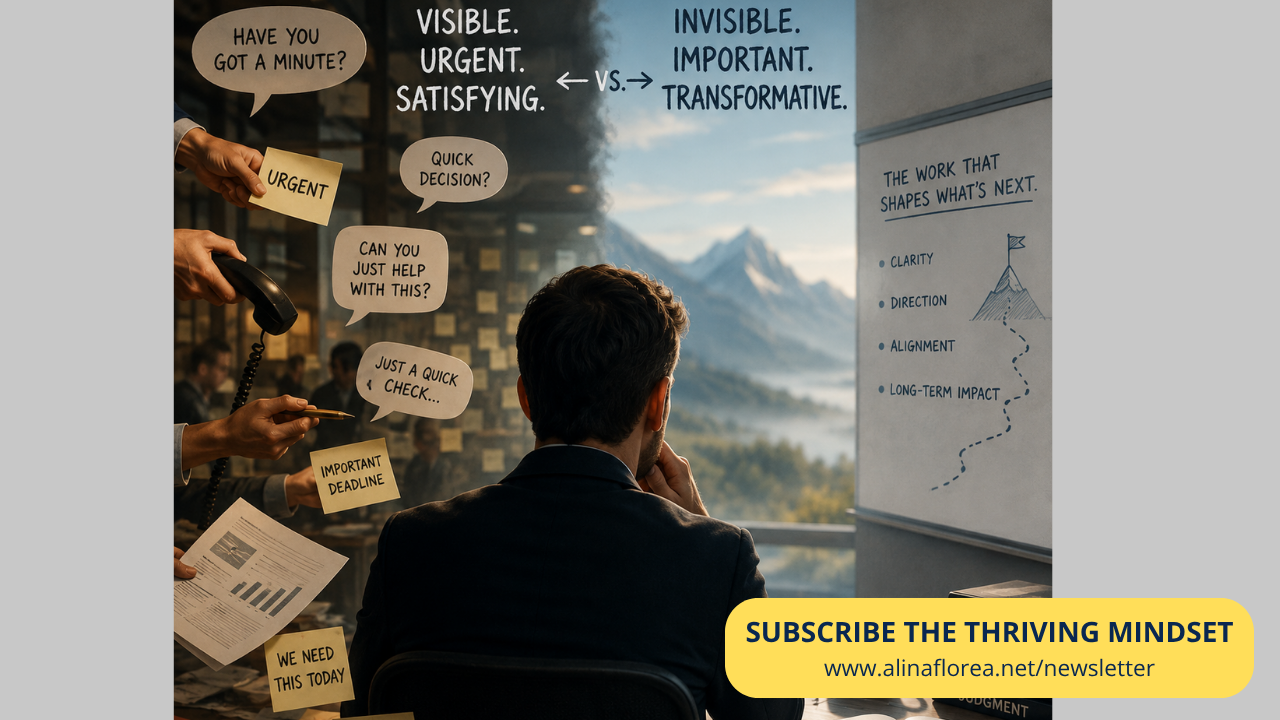
The more a leader can see, the more there is to consider. The more experience a leader accumulates, the more ways they know about how things can go wrong. And the more often anticipation has protected them, the easier it becomes to treat continuous anticipation as the price of staying ahead.
Eventually, the advantage begins to consume some of the capacity that created it.
Attention remains distributed across possibilities. The mind keeps scanning. Slowing down feels risky precisely because the leader knows enough to imagine what might happen while attention is elsewhere.
Yet, being ahead was never the same as eliminating surprise.
It meant occupying a position from which emerging reality could be seen with sufficient clarity before it demanded a reaction.
There is a significant difference between those two positions.
One keeps the leader ahead of change.
The other asks the leader to stay ahead of every possible version of change.
No amount of speed can close that distance.
When staying ahead requires you to keep every plausible future within reach, are you still leading uncertainty, or has your relationship with uncertainty started leading you?
**********
If slowing down feels incompatible with staying ahead, the issue may not be the pace itself. Sometimes, the harder part is deciding which possible futures genuinely require your attention and which ones you keep close because being surprised has become unacceptable.
If you recognise this tension in the way you lead, we can explore it in a 1:1 Executive Coaching conversation.
How can I support you?
The Executive Mindset - From senior performance to enterprise-level leadership and business maturity.
The Manager Mindset - One-on-one coaching designed to boost your performance and enhance your sense of fulfilment and satisfaction in life.
Master Your Resilience - Group coaching that helps you navigate life's challenges with greater ease and flow, empowering you to thrive through adversity.
Growth Mindset for New Managers - Your online autonomy training is designed to catalyse your personal growth and ensure your fast transition to your first management role.
Strategy Conversation (FREE) - Let’s craft your personalised roadmap for transformation. Discover where coaching can take you in just 6 months with a free, strategic call to set your path toward success.
Have You Got a Minute?