What If Your Productivity Is Actually a Stress Response?
Why the way your brain learned to perform may become a limitation as you move into senior leadership
Reading time: 3 minutes
Summary
Engineering managers often build their careers by becoming exceptionally good at analysing, solving and acting under pressure. But as their roles become more senior, the value they are expected to create changes. Neuroscience offers an interesting explanation for why the old recipe for performance remains so compelling — even when the job increasingly requires reflection, strategic thinking and the ability to resist solving too quickly.
Before deciding if this article is for you, consider:
- Do you feel more productive after solving ten problems than after spending two hours thinking about one important question?
- When your calendar gives you space to think strategically, how long before you reach for something operational?
- Has speed become such a strong marker of competence that slowing down feels uncomfortable?
- Are you still personally solving problems that your managers could learn to solve without you?
- Has your management role evolved faster than your own definition of what productive work looks like?
What If Your Productivity Is Actually a Stress Response?
Alan had started noticing a few strange things about himself.
He was at his best when there was a lot going on. A difficult client, an unexpected problem, a project falling behind, three decisions waiting for him; somehow, all of that made him sharper. He could move fast, separate what mattered from what didn't, make decisions and get people moving again.
He had always been like this. And it had served him well.
What felt strange was what happened when there was no fire to put out.
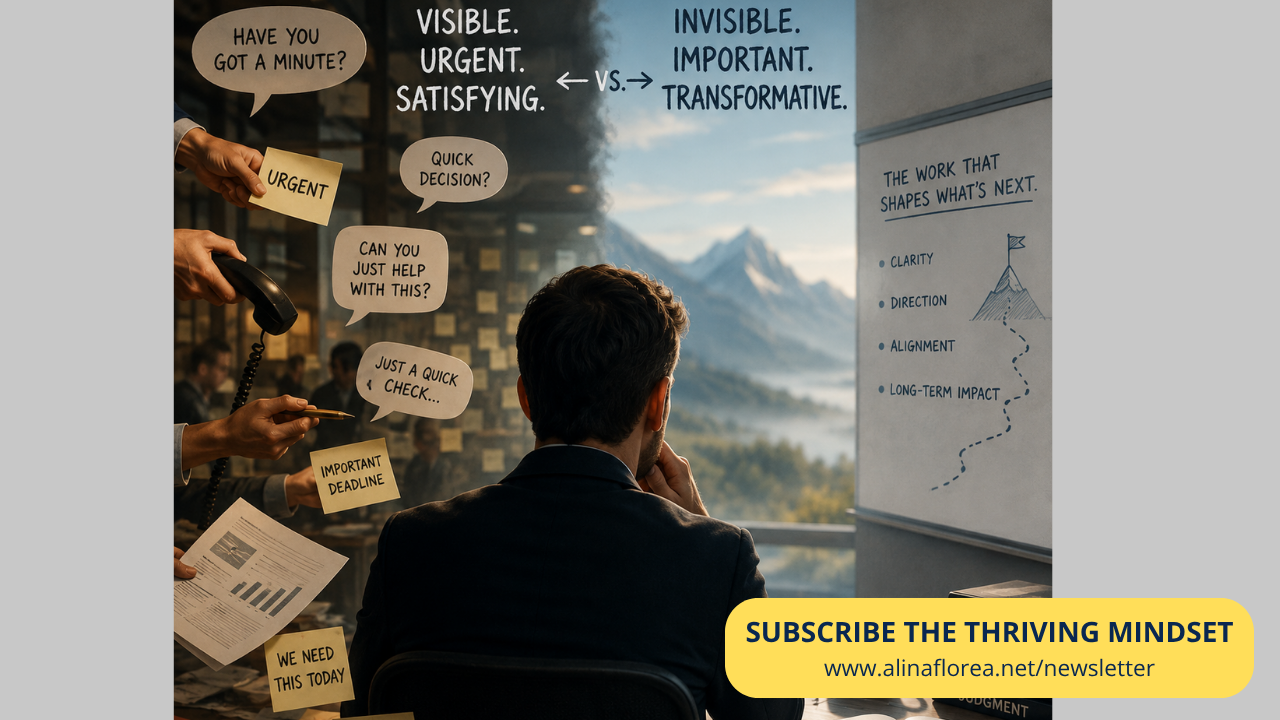
Since moving into a more senior role, Alan had started blocking time in his calendar for strategic work. Two hours, no meetings. He knew he needed it.
Yet twenty minutes into that protected time, he would find himself checking his email. Or Teams. Or remembering something he should follow up on.
And when an operational problem did appear, there was almost a sense of relief.
"Finally. Something concrete."
He had noticed other things too. Sometimes he stepped into problems his managers could probably solve themselves. Sometimes he heard himself providing the answer before asking what they thought. And, strangely, a day full of problems solved felt productive, while a day with two important strategic conversations could end with the uncomfortable feeling that he hadn't done very much.
Alan wasn't struggling. Quite the opposite. He was a high performer.
Which made me wonder whether the interesting question wasn't how productive he was, but what his brain had learned productivity was supposed to feel like.
What if pressure has become familiar?
There is a neuroscience perspective on this that I think managers, particularly those coming from engineering and other technical professions, would benefit from knowing.
The brain is, among other things, a prediction machine.
It continuously uses past experience to anticipate what is happening and what response is likely to work. This makes humans extraordinarily efficient. Imagine having to consciously work out every movement every time you drove a car. Or having to analyse a familiar technical problem from first principles every time you encountered it.
Expertise is possible partly because we don't do that.
Years of experience allow the brain to recognise patterns and produce responses that have worked before. The more often those patterns work, the more available they become.
This is enormously useful.
Until one day when your job changes.
The promotion changes your role overnight. But not your brain.
Alan had spent years in environments where problems required action. He had become good at analysing quickly, deciding, intervening and checking the result. Later, as a first-line or middle manager, many of those same abilities continued to produce results.
Problem. Analysis. Action. Result.
And plenty of evidence that what he was doing was valuable.
His brain had accumulated a very convincing history.
Then the job quietly becomes a different job
Something important happens as you move up through the management ranks.
At first, you are expected to understand the strategy and connect your team's work to it. As you become more senior, you are increasingly expected to contribute to shaping that strategy yourself.
That requires a different kind of work.
You still need to solve problems. But you also need to notice patterns before they become problems. To connect signals that may initially appear unrelated. To question assumptions that have become organisational truths. To consider what might happen rather than only what is happening. To identify your assumptions rather than acting on autopilot. To stay with uncertainty long enough to see alternatives.
And sometimes you need to spend two or even more uninterrupted hours thinking about something without having anything particularly impressive to show for those hours.
This is why I don't think strategic thinking is simply operational thinking applied to bigger problems.
Yet we often treat the transition as if it were.
Newly promoted directors often hear: "Now it's time to become more strategic."
Alan understood that perfectly well.
What he hadn't understood was why doing it felt so unnatural. What he probably expected even less was the discomfort of no longer feeling efficient according to his old recipe for performance and the realisation that adjusting to a different definition of effectiveness would take time.
There is another piece of neuroscience worth knowing
Our nervous system also changes the conditions under which we think.
Under sympathetic activation, the part of the autonomic nervous system associated with our stress response, attention tends to narrow. The brain becomes biased towards what needs to be dealt with now: identify the threat, focus resources on it, respond quickly, restore safety. In modern working life, the threat is rarely about survival. Yet the same readiness to act can make an urgent email, an escalating project issue or a client problem feel as if everything else must wait until this is solved.
The brain also has what neuroscientists call the default mode network, associated with a more internally directed form of cognition, including reflection, making connections and aspects of creative thinking, and allowing for long-term vision and planning.
In management and in life in general, we need both.
The interesting issue for high performers is what happens when one mode becomes so familiar that we keep returning to it.
Some people spend years learning to perform exceptionally well under pressure. Their sympathetic nervous system is repeatedly activated, their attention narrows, they focus, act, solve, and get rewarded for it.
Eventually, that state can start to feel remarkably similar to productivity.
This doesn't mean that being productive is a stress response, nor that focus and urgency are somehow bad. It means something more nuanced:
The state that makes you exceptionally good at dealing with what is demanding your attention may not always be the state that helps you notice what deserves your immediate attention.
For a senior leader, that distinction matters.
Two hours for strategy may not be enough
This is also why putting a "STRATEGY" block into your calendar doesn't necessarily solve the problem immediately
You can protect Friday afternoon from meetings and still bring the same operating mode (read behaviour) into those hours.
What's the objective? What are the facts? What's the problem? What are our options? What's the decision? Who does what by when?
Useful questions.
But strategy sometimes requires you to resist the urge to close the question too quickly.
What are we not seeing?
What are we assuming will remain true?
Why are these two apparently unrelated things happening at the same time?
What would we do differently if the constraint we have learned to accept disappeared?
What might become important before anyone is asking us about it?
You may have made space for strategic thinking in your calendar without yet making space for it in your brain.
Your previous success isn't the enemy
I wouldn't tell Alan to stop being operational.
That would make little sense. His ability to focus, decide and execute is part of what makes him valuable, and an appointment at senior leadership level doesn't magically remove the need for any of those things.
The transition is about adding range.
And this is where another neuroscience concept becomes useful: neuroplasticity.
If the brain makes predictions based on previous experience, changing how we operate requires giving it new experiences from which to predict.
Not once. Repeatedly.
Alan needs experiences in which he spends time exploring a question and later discovers that way of thinking mattered. Experiences in which he doesn't only solve his reporting manager's problem and watch that manager grow. But experiences in which a conversation that produced no immediate action changes a decision three months later.
He needs to discover that noticing can be work; connecting can be work; thinking and visualising is work; mapping once and correcting it three times is work; formulating better questions is work; acknowledging what is not yet known can be work. Or even refraining from intervening can sometimes be leadership.
In other words, moving into senior leadership requires more than doing more, and is often much about what we can learn differently about who we need to become.
It requires teaching your brain that value no longer always feels like action or speed.
Perhaps productivity needs a promotion too
We tend to assume that when someone's responsibilities become bigger, their existing definition of productivity can simply follow them immediately.
This usually happens, but it takes time. And this is exactly why it involves a transition period.
At one stage of your career, a productive day may genuinely be one in which you solved ten technical or even organisational problems.
At another, the most valuable thing you did that day might have been noticing the question nobody else was asking.
The difficulty is that the first gives you immediate evidence of usefulness. The second often doesn't.
Your brain naturally prefers what it already knows. And if years of success have taught it to associate pressure, action, resolution and visible output with value, a quieter form of leadership may initially feel surprisingly unproductive.
Nothing particularly strange was happening to Alan after all.
Perhaps the strange thing would have been expecting years of successful patterns to disappear simply because his title had changed.
Alan's work now is not to get rid of the brain that made him successful.
It is to give it a larger repertoire.
And perhaps that starts with a different question at the end of a working day:
When there was no urgent problem to solve today, how easily could you still recognise that you were doing valuable work?
**********
The way you have learned to be productive influences much more than how much you get done. It shapes what captures your attention, what feels worth your time and, ultimately, where you believe you create value.
If you recognise the tension between being exceptionally good at solving what is urgent and making enough space for the strategic thinking your senior role now requires, this is exactly the kind of leadership transition we can explore in a 1:1 Executive Coaching conversation.
How can I support you?
The Executive Mindset - From senior performance to enterprise-level leadership and business maturity.
The Manager Mindset - One-on-one coaching designed to boost your performance and enhance your sense of fulfilment and satisfaction in life.
Master Your Resilience - Group coaching that helps you navigate life's challenges with greater ease and flow, empowering you to thrive through adversity.
Growth Mindset for New Managers - Your online autonomy training is designed to catalyse your personal growth and ensure your fast transition to your first management role.
Strategy Conversation (FREE) - Let’s craft your personalised roadmap for transformation. Discover where coaching can take you in just 6 months with a free, strategic call to set your path toward success.
Have You Got a Minute