THE ARCHITECTURE OF TRUSTWORTHINESS
Part 2: Intimacy
When People Trust Your Judgement but Keep Their Distance
Reading time: 3 minutes
Summary
For accomplished leaders, professional competence, efficiency, and strong executive presence are often the qualities that earn them respect. Yet these same qualities can sometimes make colleagues hesitant to approach them with unfinished thoughts, uncomfortable concerns or disagreements. The manager expects openness and timely communication, while employees quietly learn how much preparation is necessary before entering a conversation.
This article explores intimacy, one of the four variables in the Trustworthiness Equation, and how everyday leadership behaviours influence the safety people experience in professional relationships. When colleagues trust your judgement but remain cautious about revealing their own uncertainty, what happens to the quality of information, initiative and collective thinking available to you as a leader?
Before deciding if this article is for you, consider:
-
When someone approaches you with an unclear problem, how comfortable are you allowing the conversation to unfold without immediately seeking a solution?
-
How much preparation do your colleagues feel they need before bringing you a concern or an unfamiliar idea?
-
When you challenge someone's reasoning, how confident are they that you are questioning their thinking rather than judging their competence?
-
Do people genuinely disagree with you, or have they learned which disagreements are worth the effort?
-
When your colleagues are uncertain, do they come to you to think together, or wait until they have something they believe you will find acceptable?
I Can Feel the Distance, but I Don't Know Why
“We are here to get things done and achieve our objectives. I don't see why we should spend time on all these other things.”
Over the years, I have heard variations of this statement from entrepreneurs and managers during coaching conversations and leadership programmes. Often, the people saying it are accomplished professionals, genuinely concerned about their employees and perfectly willing to support them. They take pride in running an efficient organisation, maintaining high standards and helping people develop the competence to work independently.
For them, the professional relationship has a clear purpose: getting the work done. And their experience provides plenty of evidence that this approach works.
Meetings have an agenda. Expectations are clear. Problems are addressed promptly. Employees know when to involve their manager and are encouraged to come with solutions rather than problems.
In relatively predictable environments, this can work beautifully. Everyone understands the assignment, knows what information is needed and can make progress without extensive consultation.
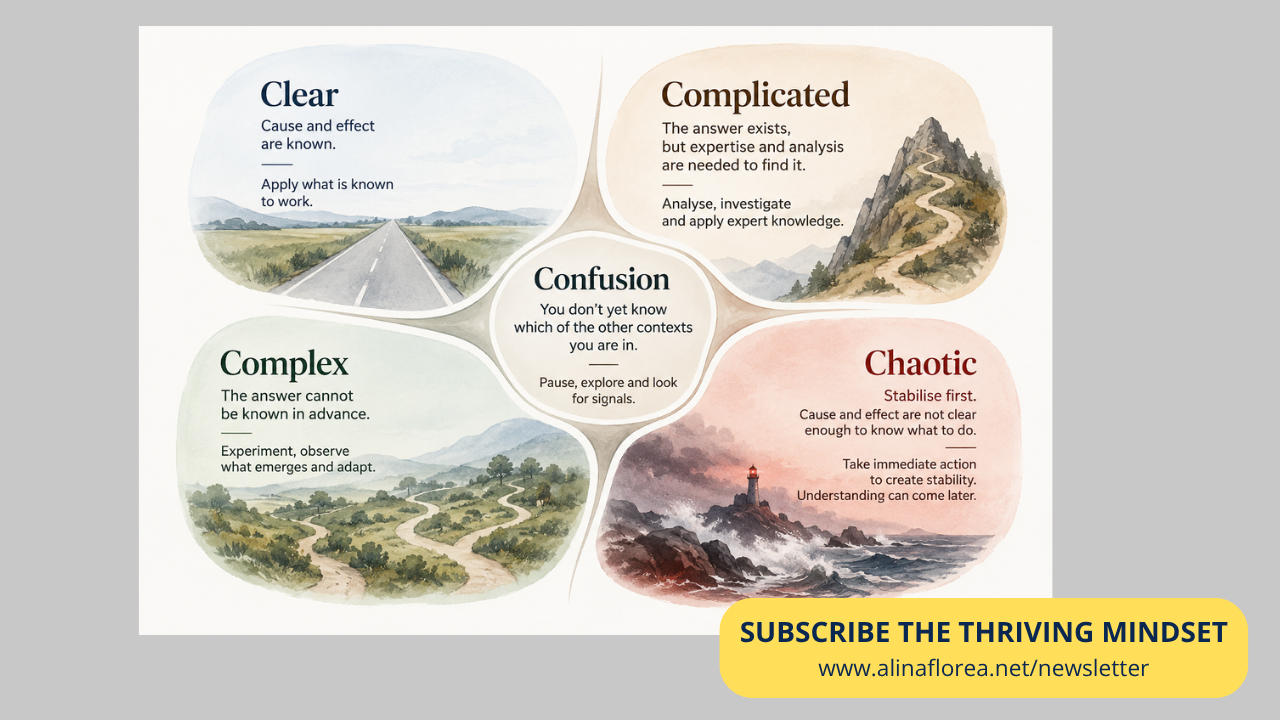
Complications arise when the organisation enters territory where the problem itself is still being understood.
Imagine a project manager who notices several inconsistencies in a major implementation. Nothing has failed yet, and the available data supports more than one interpretation. He knows his director expects well-prepared discussions, so he investigates further, consults two colleagues and postpones raising the issue until he can present a credible recommendation.
By the time he does, the organisation has lost several days. His director is frustrated. “Why didn't you involve me earlier? We could have made a decision together.”
The project manager thought he was demonstrating professionalism. The senior manager thought he had made himself available.
Neither has quite understood what happened between them.
I find this particularly interesting in coaching because, at both ends of the relationship, both feel there is a sense of a certain distance in the relationship. People are respectful, cooperative and competent, but somehow less forthcoming than expected. The higher-up manager cannot understand why his reports (managers or not) hesitate to involve him, especially when he has repeatedly asked for timely communication.
What the more senior manager rarely sees is the amount of preparation their reports consider necessary before feeling comfortable entering a conversation with them.
The Part of Trustworthiness We Often Misunderstand
In my previous article, I explored Self-Orientation through the Trustworthiness Equation developed by David Maister, Charles Green and Robert Galford:
Trustworthiness = (Credibility + Reliability + Intimacy) / Self-Orientation
This second article concerns Intimacy, a word that rather sounds out of place in management discussions or contexts.
I understand the hesitation. Many executives associate intimacy with personal disclosure, emotional closeness or conversations that belong outside the workplace.
In the Trust Equation, however, intimacy refers to the degree of safety people experience when entrusting someone with something important to them.
In management, that something may be a concern they cannot yet substantiate, a mistake they are struggling to explain, a disagreement with a senior decision or an emerging idea that might sound rather foolish before it has been properly developed.
Think of the people you turn to when you need to think aloud about a difficult decision. You probably choose them for their judgement, but also because you can afford to be uncertain in their presence. Because you do not feel judged and you like how you and whatever you are disclosing will be treated. With gentleness, care and consideration, even though you know you will be challenged and held accountable.
Now consider whether your own colleagues experience that freedom with you.
A person may have enormous confidence in your professional judgement and still feel uncomfortable allowing you to see how uncertain they are about theirs.
When Efficiency Becomes the Relationship Standard
One characteristic I frequently encounter in highly achievement-oriented managers is their ability to extract practical value from almost every conversation.
Bum! They immediately connect what you say to how they can use it for achieving. They listen for the essential information, identify what needs to happen and move quickly towards a decision. Their time is scarce, and they have learned to protect it.
A question such as “What exactly do you need from me?” comes naturally.
Yet I have noticed how differently that question can land depending on the person receiving it and the moment in which it is asked.
Someone who has a clear request will appreciate it. (Most likely this person also has a significant tendency for hyper-achieving.) However, someone who is still trying to understand an uncomfortable situation may hear an expectation they are not ready to satisfy or a lack of appropriateness in their professional background or presence.
The next time, they would prepare more thoroughly before asking for a conversation. Or might even avoid exposing themselves to the interaction with you based on their perception of feeling judged.
Gradually, an informal rule develops: access to the manager requires a sufficiently mature problem, a concise explanation and, preferably, a proposed solution. Lack of such means less professionalism and underperformance.
Nobody necessarily establishes this rule explicitly. It emerges from dozens of ordinary interactions.
The manager may be delighted to see people become more autonomous but still frustrated by the time required for solutions to arise. What is harder to recognise is that some of this apparent autonomy is actually avoidance of conversations in which people expect to feel inadequate, rushed or insufficiently prepared.
I have seen senior managers become increasingly irritated by late escalations from their reports while remaining unaware of how strongly their own conversational habits encourage the latter to postpone them.
There is a considerable operational cost to this.
Complex problems rarely arrive in a neat format. Their early signals are ambiguous, the available information is contradictory, and the most useful contribution from another person may be a question that changes how the problem is framed and understood.
If employees believe they must first make sense of everything before approaching their manager, the organisation loses opportunities to think collectively when that thinking could make the greatest difference.
Efficiency has become an expectation imposed on the relationship, even when the work would benefit from a less efficient conversation.
The Distance Your Executive Presence Can Create
A similar phenomenon appears in how senior leaders exercise executive presence.
I have worked with managers who are articulate, intellectually demanding and exceptionally confident in their reasoning. They can enter a difficult meeting, organise the discussion and establish direction with remarkable speed.
People admire these qualities. Some may even aspire to develop them.
Yet admiration does not necessarily make someone easy to approach.
Consider a director who listens to a proposal, immediately identifies its weaknesses and offers a much stronger alternative. His reasoning is sound and most probably saved the team considerable time.
What he may not realise is that the colleague who presented the proposal had been trying to explore an unfamiliar possibility, rather than defend a finished recommendation.
After several such experiences, the colleague learns to bring ideas only when they are sufficiently developed to withstand the director's scrutiny.
The director may subsequently complain that his team lacks initiative or strategic thinking.
From his perspective, he has always encouraged both.
This is where I believe executive presence deserves a more demanding interpretation. Confidence and intellectual authority are valuable, but their effect on other people depends heavily on how they are exercised.
When a leader's responses consistently communicate that the answer should already be clear, colleagues become reluctant to expose the stage of thinking in which clarity has not yet emerged.
The same applies to disagreement.
A leader may genuinely invite alternative opinions and still make disagreement exhausting through the speed, intensity or certainty of their responses. People eventually learn which discussions are worth having and which are better avoided.
Psychological safety is closely related to this experience. It concerns whether people believe they can take interpersonal risks, including speaking up, asking questions or acknowledging mistakes, without being punished or humiliated.
Intimacy adds something more personal to the picture: the confidence that this particular relationship can accommodate candour, uncertainty and the occasional uncomfortable conversation.
And people form that judgement through experience, often from interactions their manager barely remembers.
What Happens When People Learn to Keep Their Distance
One of the more uncomfortable discoveries senior leaders can have in leadership coaching is that a manager can be highly respected and still be someone people prefer to approach only when necessary.
Their competence is not disputed. Their intentions may be perfectly decent. Employees may even describe them as having vision, being fair, supportive and deeply committed to the business.
Yet the conversations they have with that manager remain carefully managed.
I would be cautious about interpreting this as a lack of courage or openness on the employees' part. People are usually quite perceptive about the conditions under which a relationship functions comfortably. They learn when to speak, what to leave out and how much uncertainty they can safely reveal.
The manager experiences the outcome of these adjustments without necessarily recognising their origin.
“They should have told me earlier.”
“Why do they wait until the last moment?”
“I don't understand why they don't challenge me more.”
These are questions I usually explore with leaders in coaching, going beyond the usual explanations about communication skills or accountability.
Sometimes the answer lies in the accumulated experience of working with that manager.
Professional intimacy does not require personal revelations, informal friendships or endless conversations about feelings. A reserved leader can establish a remarkable degree of trust through discretion, patience, genuine curiosity and the ability to remain approachable when another person's thinking is incomplete.
Much of this becomes visible in ordinary moments: what happens when someone hesitates, how the manager responds to an inconvenient question, whether a concern receives attention before it becomes urgent, and whether disagreement changes the atmosphere between two people.
I would invite you to consider the colleagues who report directly to you, particularly those you regard as highly competent.
When they are unsure, do they come to you to think together, or do they wait until they have something they believe you will find acceptable?
The difference may tell you considerably more about the intimacy in your professional relationships than the quality of the results they deliver.
A Closer Look at Intimacy in Management
The situations explored in this article are only a few of the ways managers can unintentionally influence how comfortable others feel approaching them.
I have brought together 14 patterns I encounter in management relationships, with concrete examples of what managers do, how those behaviours may be experienced by others and what happens to the relationship and the mutual trust over time.
Some are surprisingly difficult to recognise in yourself, particularly when the behaviours involved have contributed to your professional success.
Explore further 14 Patterns that shape Intimacy in management.
You may recognise something familiar in these examples. More importantly, you may begin to understand a reaction from someone you work with that has puzzled you for some time.
If you are curious about the distance between how you intend to lead and how others experience working with you, this is a valuable territory to explore in executive coaching.
I invite you to continue that exploration with me in a 1:1 Executive Coaching Discovery Call.
**********
How can I support you?
The Executive Mindset - From senior performance to enterprise-level leadership and business maturity.
The Manager Mindset - One-on-one coaching designed to boost your performance and enhance your sense of fulfilment and satisfaction in life.
Master Your Resilience - Group coaching that helps you navigate life's challenges with greater ease and flow, empowering you to thrive through adversity.
Growth Mindset for New Managers - Your online autonomy training is designed to catalyse your personal growth and ensure your fast transition to your first management role.
Strategy Conversation (FREE) - Let’s craft your personalised roadmap for transformation. Discover where coaching can take you in just 6 months with a free, strategic call to set your path toward success.
On the Same Topic
People learn how safe it is to approach a leader through repeated interactions, often long before either party recognises the pattern. These three articles examine how self-orientation, habitual problem-solving and professional competence can shape the relationship in ways that discourage openness, disagreement and independent thinking.
The Architecture of Trustworthiness | Part 1 — Self-Orientation
A manager can be genuinely interested in others while unconsciously bringing the conversation back to their own contribution, judgement or importance. When people sense that the leader's self-image is also at stake, how much freedom do they feel to disagree, challenge or disappoint?
Have You Got a Minute?
A manager who is always ready to help may appear exceptionally approachable. But if every conversation quickly becomes an opportunity for the manager to provide an answer, employees may feel welcome to bring problems without feeling equally welcome to explore their own thinking.
When Operational Strength Becomes a Strategic Limit
A leader's technical and operational competence can inspire considerable confidence. It can also make colleagues reluctant to expose incomplete reasoning or propose alternatives they cannot yet defend. What makes a manager valuable as a problem-solver may unintentionally make that same manager difficult to think aloud with.