What You Tolerate Is What You Endorse
Reading time: 3 minutes
Summary
Execution rarely deteriorates because people do not know what to do. It deteriorates when behaviors that breach stated values pass repeatedly in the presence of authority. What is not addressed does not remain neutral. It becomes a signal. Over time, tolerance hardens into endorsement, and the organization adjusts decisions, accountability, and risk-taking around what leadership consistently allows.
By the time execution patterns visibly weaken, the decisive moments are already past. The system has learned where boundaries actually lie, not from what was said, but from what was permitted to stand. What appears later as misalignment or poor follow-through is often the delayed effect of behaviors leadership chose not to confront.
Is this article for you? Here are three questions to guide your assessment:
-
Which behaviors continue unchallenged because addressing them feels inconvenient or costly?
-
Where has silence effectively replaced an explicit leadership decision?
-
When execution erodes later, will you see it as operational failure or as the accumulated cost of tolerated breaches?
When a Behavior Tests the System
Inside organizations, behaviors are tested continuously. All organisational routines can become subject of it: project meetings, reviews, escalation calls, steering committees, performance discussions, annual info to all employees — you name it: anywhere authority is present.
A behavior does not need to be disruptive to perform this test. It is easy and obvious to think about the annoying sales VP who likes to hear himself talking in the meetings. Or to imagine a furious operational lead on the production shop floor. But the transgressive behaviour does not need to be loud or angry. Picture these: a commitment remains open during a review; a decision that should have been direct and straightforward is redirected through side agreements; a value is set aside “just for this case”. The routine continues but chances are the deviation remains unnamed.
Each time this happens, the behavior encounters authority and passes through unchanged. From the system’s perspective, that encounter is decisive. It has learned where boundaries actually lie.
As these situations repeat across routines, people stop treating them as isolated moments. They observe what consistently survives without consequence and adjust accordingly. Long before anyone speaks about culture, the system has already mapped what is safe to repeat.
How values are bypassed without being challenged
When these situations are later justified, the explanation rarely addresses the behavior itself. It refers to context. Pressure. Performance. Timing. The language used is usually consistent with the organization’s stated values, even when the behavior clearly contradicts them.
In organizations that claim accountability, commitments are expected to be precise. Yet in reviews or steering discussions, some commitments remain deliberately open. “Let’s see how it develops”. “We’ll decide once we have more clarity”. No follow-up occurs. The explanation is that locking decisions too early would be irresponsible given the uncertainty.
Where respect is named as a value, interruptions, dismissive reframing, or unilateral decisions may still occur in routine interactions. They pass without comment, often because the person involved is seen as decisive, under pressure, or critical to delivery. Respect remains visible in language, but its boundary shifts in practice.
In systems that emphasize collaboration, alignment routines often end without naming unresolved disagreement. Objections are noted but not addressed. The justification is that cohesion matters more than friction. Collaboration survives as a principle; disagreement becomes something to manage quietly.
These explanations are not invented. They are coherent within the logic leaders use to keep things moving. What they have in common is that they redirect attention away from the breach and toward a justification that feels operationally responsible.
As this repeats, values remain present as references, but they stop functioning as limits. People learn not from what is stated, but from where exceptions are consistently granted.
Tolerance becomes a system decision
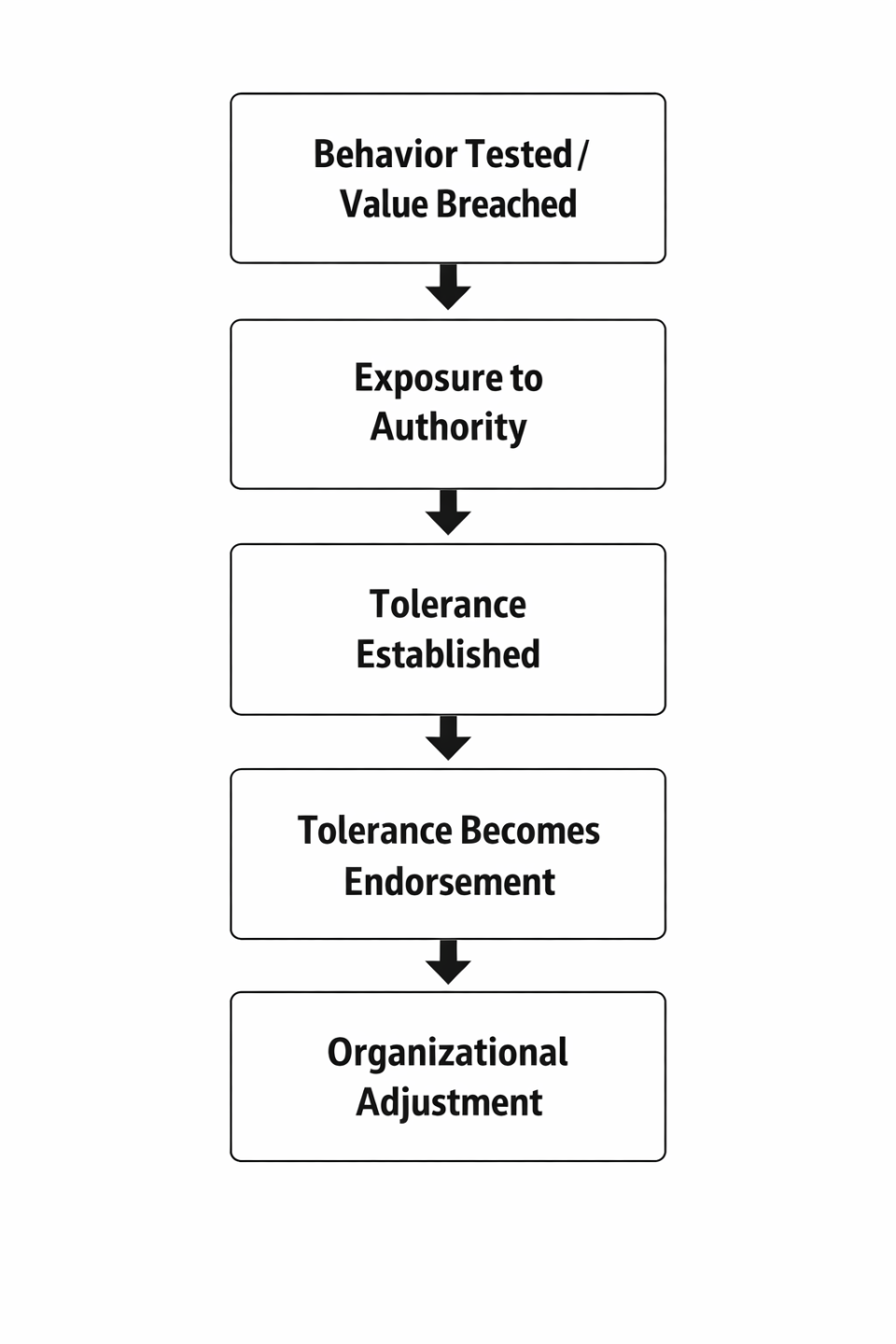
Once a behavior passes repeatedly through organizational routines without consequence, it stops being treated as situational. From the system’s perspective, it has been tested and cleared. No further interpretation is required.
This is how tolerance operates. It does not remain contextual, and it does not stay neutral. It produces a stable signal that the organization incorporates into its way of operating. A behavior that survives exposure to authority becomes predictable. And and predictability is what systems rely on.
At this point, people stop orienting themselves by values and start orienting themselves by outcomes. They watch which behaviors move things forward, which ones are corrected, and which ones quietly reshape decisions without being named. The organization adjusts accordingly, not through discussion, but through repetition.
What makes this shift difficult to notice is its gradual nature. Language remains unchanged. Routines continue. Performance may even hold. The change occurs elsewhere: in what people no longer raise, where they leave room for ambiguity, and which commitments they stop treating as binding.
Tolerance, here, is not the absence of leadership. It is leadership exercised indirectly, through precedent. The system does not distinguish between what is explicitly endorsed and what is consistently allowed. It learns from both — and it trusts the latter.
When tolerance hardens into endorsement
Once a behavior has proven that it can pass without consequence, it no longer needs protection. The system treats it as legitimate. People stop checking whether it aligns with stated values and start using it as a reference for their own choices.
This is the point at which tolerance becomes endorsement. Not because leadership has approved the behavior, but because stability has replaced uncertainty. What survives consistently acquires authority of its own.
As this happens, informal norms begin to outweigh formal expectations. Commitments become conditional where precision has not been enforced. Decisions migrate away from formal forums when indirect routes prove safer. People adapt their behavior to what has already demonstrated its viability.
The organization does not experience this as a loss of standards. It experiences it as clarity. The rules are no longer ambiguous; they are simply different from those that are written.
At this stage, alignment remains visible in language and documents, but execution follows a different logic. It follows the logic of what leadership has made safe to repeat.
How execution adapts to what is endorsed
Execution does not break suddenly when tolerance hardens into endorsement. It recalibrates. The organization adjusts its effort, attention, and risk-taking to match what has proven reliable in practice.
Decisions begin to take longer, not because they are more complex, but because experience has shown that delay carries little cost. Commitments lose precision where precision has not been enforced. Accountability narrows to areas where consequences are predictable and avoids those where standards have remained flexible.
This adaptation is not random. It is disciplined. People invest energy where expectations are stable and withdraw it where boundaries are unclear. Initiative concentrates around what leadership consistently protects and retreats from what leadership has left ambiguous.
Over time, this produces a recognizable execution pattern. Plans appear aligned, priorities are formally agreed, yet delivery fragments at critical points. What leadership later names as execution gaps are, in fact, the logical outcome of a system that has learned which behaviors are safe, which ones are optional, and which ones expose risk.
At this stage, execution is no longer responding to strategy or stated values. It is responding to endorsement. The organization is not failing to execute. It is executing precisely in line with what the leadership system has validated through tolerance.
In senior roles, distance from day-to-day execution often creates the impression that culture operates elsewhere, at lower levels, or in interactions one does not directly witness. In reality, the opposite is true. The higher the position, the fewer the moments that truly matter — and the more weight each of them carries. What is tolerated at this level does not remain an exception; it becomes a reference.
This is why attempts to address execution issues later tend to circle around symptoms. By the time concerns reach formal agendas, the underlying trade-offs have already been made. Not through explicit choices, but through repeated decisions not to intervene. The system has already adjusted to those decisions, and any subsequent discussion starts from ground that has already shifted.
For senior managers, this creates a narrow window for meaningful influence. It is not located in grand interventions or strategic resets, but in the small number of moments where a behavior meets authority and waits for a response. When those moments pass without consequence, the organization does not remain undecided. It concludes, with precision, what leadership is prepared to stand behind.
- Which behaviors consistently pass in the presence of authority?
- What has silence already decided inside your leadership system?
- Which values hold under pressure — and which quietly recede?
- Where has tolerance replaced an explicit leadership decision?
- What execution patterns reflect what leadership has protected?
Until next time, may authority, clarity, and execution stay aligned.
Alina Florea
The Invisible Organization
How can I support the managers in your organisation?
Team Coaching - Working with leadership teams to surface unspoken dynamics, clarify decision ownership, and restore execution where alignment repeatedly stalls. Let's meet in a conversation grounded in your real context to see whether and how this kind of work would be relevant for your organisation.
The Manager Mindset - One-on-one coaching for managers and senior leaders whose performance is solid, but whose clarity, energy, or sense of fulfilment is under pressure. The focus is on strengthening leadership mindset and decision-making capacity for sustained effectiveness.
Growth Mindset for New Managers - An online autonomy training for professionals stepping into their first management role. It builds the internal foundation needed to assume authority with confidence, clarity, and reduced dependency from day one.